Showing posts with label film. Show all posts

Friday, August 14, 2009

From playwright Mitch Vermeersch

It would be difficult to imagine film noir without the smoking. The cigarette is a visual element of the films as quintessential and recognizable as the fedora or the silhouette.

One reason for this is the clever way in which directors used cigarettes for elegantly crafted character moments. In Jules Dassin’s beautiful film Theive’s Highway, Valentina Cortese produces a cigarette she hopes Richard Conte will light for her. He declines. Ignoring the fifteen or so matches that have been lit and held out to her by hopeful male patrons, she takes the cigarette from his mouth and suggestively lights her own smoke off the burning end of his. These are the moments that characterize film noir. It would be difficult to imagine the stalwart noir detective without a burning cigarette firmly planted in his countenance. The same goes for the lusciously villainous femme fatale. What else is she going to do with those sexy, gloved fingers?

But what would it look like if you were forced to remove the cigarette from the noir film? Humphrey Bogart walks into a bar from the street and takes a seat alone amid the swirling maelstrom of greased hair and wild dresses. There is a rhumba band playing and people are dancing but he is too solitary and world-weary to dance. The bartender brings him a glass of dark dark liquor as he surveys the room for the crook he’s tailing, all the while looking out for the girl who’s tailing him. He is a man at once within and detached from the room. To calm himself he reaches into his jacket pocket and casually pulls out his pack of… gum. He lets a stick dangle coolly from his lips, tastes the soothing menthol soon to fill his mouth with minty freshness… sounds silly doesn’t it?

My point is that to take the cigarettes out of film noir would be like taking the color gels out of a theater. You could get along fine without them, but the aesthetic of a lot of plays would likely feel very awkward. However in this city, as in many others, they’ve taken the smoking out of everything. Including the theater. See a production of Glengarry Glenross and the masculine, hard smoking real estate agents (if they’re lucky) will be exhaling electronically controlled water vapor or (if they’re not lucky) thin rolls of bubble gum candy wrapped to look like Marlboro Reds. Because Heist Play is inspired and informed by the world of film noir, to remove the smoking from the world of the play would have felt somewhat unjust. Thusly, we’re forced to find creative ways to portray smoking, and you’ll have to forgive us for any gaps in the authenticity of our substitutions.

Personally, I am a stickler for authenticity when it comes to things like this, but I can’t bring myself to argue with the reasoning behind this obstacle. There are many good reasons why so many major cities have instituted smoking bans. There are many good reasons not to smoke. Noir films were made at a time when smoking was a much more accepted and universal habit. Today, children come out of the womb familiar with the inherent health risks. There are, however, those of us who still enjoy it, and the culture of smoking today is much different than in the days of noir. In non-smoking cities like this one, smokers gather at regular intervals outside public buildings in small congregations. At once within and detached from the population, these congregations meet to talk about nothing in particular. They are united only by the individual enjoyment they get from partaking in a particular vice, an enjoyment not unlike the kind I feel watching noir movies, films populated by lonely characters whose flaws and personal interests set them apart from the public at large.

Desire for a particular vice sometimes forces you to be creative when it comes to getting your fix. It is this desire that occasionally sends me on extensive searches for hard to find noir titles. It sends smokers out of doors to find small, secluded corners where they can smoke among those who share the same interest. Vice breeds a strange congregation, but it’s a congregation that, like most, is ever willing to welcome a newcomer. Smokers light smokes for other smokers today the same way they did in the days of Sam Spade and Phillip Marlowe.

And so when Heist Play opens on Sunday, you will find me standing outside the Side Project Theater smoking to calm my nerves during the act breaks with a handful of people who find enjoyment in the same silly activity as myself. That cigarette will end, the way all cigarettes do, and I will head back inside to take my place among a crowd of people united only by the strange enjoyment they get from watching a cast of actors tell stories onstage with fake liquor, plastic pistols, and bubble gum cigarettes.

Come see Heist Play. The space is small and tickets are going fast.

From director Allison Shoemaker

When people make ‘noir-esque’ movies today, what they mean is that they look like film noir, or the dialogue is similar in rhythm and cadence -- essentially, they’re talking about style. There are a lot of remarkable movies that fall into this category. I was entertained as hell by 'Kiss Kiss Bang Bang’ and ‘Brick.’ ‘L.A. Confidential’ and ‘The Man Who Wasn’t There’ are both beautifully shot and incredibly evocative of the genre. Here’s the thing, though: when film noir movies were being made, it wasn’t just about the style. That was a huge part of it, yes, but so was moral ambiguity and characters that refuse to inhabit a world in which one can be truly good or purely evil. The movies we now call film noir were about failed redemption, about what it is to be unable or unwilling to assert your own destiny and avoid damnation. They were about the clever banter, certainly, but also about what happens in the air between the words. When I started to think about what contemporary examples we have of that fundamental aspect of the noir tradition, a scene popped into my mind.

At the risk of sounding like an entry in ‘Stuff White People Like,’ I have to say -- I think The Wire might be the best show in the history of television. At the very least, it’s the closest thing to film noir we’ve seen this decade. As a result, it’s been on my mind a lot lately. (Fellow fans can listen for the theme song in ‘Heist Play’.) A lot of factors went in to making The Wire what it was -- talented writers, a devoted, adventurous and mostly unknown cast, a network brave enough to produce a show where the most heroic character is a gay stick-up boy who only robs drug dealers and lives by a code. This is a show you actually have to learn how to watch. You expect it to be one thing, and it’s not. It’s more. It’s a novel. It’s an epic.

I can’t exactly say I’ve stolen things from ‘The Wire’ for ‘Heist’, but it has certainly informed my work. When Katie Canavan and I started talking about Dietrich, we talked about cops who want but aren’t sure how to be more, and I was thinking of poor Beadie Russell. When Josh Davis was working to find how exactly Nick is altered when he’s drinking, Jimmy McNulty was swimming in booze through my head. When I talk, or rhapsodize, really, to my cast about the amazing things Mitch does with language, with such simple words and the great meaning they convey, I think of that scene where D’Angelo Barksdale teaches Bodie and Wallace and Poot about how chess works using the drug trade to communicate the ideas, and the total lack of expression on each of their faces as they begin to talk about the pawns. And when I want to remind myself to think about the remarkable things you can do with great characters and great actors, I think about that amazing scene in season one when McNulty and the Bunk go to investigate a crime scene that was royally botched by the first set of police who looked it over, and figure the whole damn crime out, and talk it through and figure it out, and they only ever say ‘f*ck’ and its many derivatives. Talk about inventiveness.

*

We’re a few days out from opening now. We’re close enough to opening that I am just now getting around to writing this thing I’ve been so stoked about writing. We’ve found the props (or most of them) and fitted the costumes and taped the floors. We’ve emptied a 12-pack of Old Style and need to empty many many cans of Coors Light in the next few days (for props, I swear). We’ve gotten it done. It’s a terrifying and exhilarating feeling.

It’s been a real privilege to work on ‘Heist Play’. I’ve known many of the people involved for many years, and hope to know the new ones for many more. (Katie Canavan stole my blog idea -- but how many Odes to Starbird or Melton or Stulik can one blog take? Anthem of Hornreich and Dean, perhaps?) We of The Ruckus are so fortunate to be working with such a remarkable cast and crew, and I can’t wait for the world at large to see the remarkable work they’ve been doing. I’m proud and inspired and humbled and wildly entertained. Not a bad deal, if you ask me.

Last but far from least, I’m so lucky to be working elbow to elbow with Mitch Vermeersch again. In a world of style-but-no-substance, Mitch creates these truly original plays that never fail to surprise. In ‘Heist Play’, Mitch gets to convey his love of film noir through Nick, and the passion and fascination he feels is so clearly conveyed that it cant’ help but be contagious. His braveness in breaking rules of structure and in allowing characters to be ugly people who do ugly things has created a genuinely unique work of art that has inspired me to be better and do more, and has done the same for our remarkable cast. I can’t wait for ya’ll to see it.


Back to work. Oh my wow, I hate and love scene changes. But mostly hate. But mostly love.

Monday, August 10, 2009

Noir at the Table

Submitted by actor Neal Starbird

With Heist Play, Mitch Vermeersch and The Ruckus are examining elements of film noir, a cinematic style, in the context of live theatrical performance. Got me to wondering, where else can this style be extended? There have been other stage explorations; George F. Walker's Theatre of the Film Noir being a blatant example. Certainly fashion and music can draw heavily on ideas put forward in those films (though it would be hard not to cop as simply "retro"). What about the dining room? With field-to-table emerging as the Seattle Sound of the new era, can styles and aesthetics closely associated with another medium be satisfactorily pulled across the art/craft barrier and plopped on a plate in front of us?

What sort of thing would make a meal
noir? You could easily say, "Bring a couple of bottles of Oregon Pinot, and away we go!" And, hey, that's a start! There's plenty of alcoholic beverages that lend themselves to the mood; the inhabitants of those unhappy films thought as much. In addition to the red wine, whiskey would seem appropriate. For dessert, you can throw out some deep Spanish sherry, and, of course, coffee is right in there.

And on the plate, how do we want to approach it? Little jumps to mind from the movies. Maybe the odd diner hamburger steak and fries, but maybe we can do better. Maybe we think of dark flavors, things redolent with
umami, things like mushrooms and beef. Maybe bring the burger-steak and spuds idea uptown with a heavy stew of meaty shiitake and beef shoulder braised in red wine and whiskey with some roast potatoes on the side. That feels like a delicious bowl of deep, dark americana.

Another way to look at it: seems like there's an awful lot of tension in those movies between the haves and the have-nots. Let's look at pairing high-end items with more humble ingredients. Take that expensive piece of tail we call Lobster and let it lay down with some honest, hard-working noodles. But noodles packing a bit of chili heat. Lobster with chili noodles? I'll eat that while I sit on the wharf and watch the fog roll off the bay.

Some of you may read this and wonder "where's the recipe card, pal?" Well, you know what? Sometimes in life things just don't turn out the way we expect 'em to. Ain't that a daisy?

Tuesday, August 4, 2009

The Dealer Wore Red

An attempt at noir comedy from assistant stage manager Phil Baranski

The cool Chicago breeze whipped up the edges of my duster as I stood on a lonely street corner under the full moon. I held down my fedora, nervously awaiting my contact. She was late. She was never late. Something was wrong.

Vanessa, my .38 snub nose revolver, burned a hole in my jacket pocket. A truck drove noisily by and I cocked her, ready for action. Then, like an angel in a red dress, she was there.

Julia was a vision, all done up for a night on the town. Her dress hugged the curves of her body, leaving little to the imagination. Her fur coat hung lazily on her shoulders, and her wide brimmed hat covered her curly brown hair. She walked up close her doe eyes looked right into mine with a passion unmatched in any dame I've ever seen.

"Sorry I'm late, Tiger" she said cooly, "Bad Mexican food."

She slipped me a piece of paper with the information I needed, then kissed me on the cheek. She lingered by my ear, whispering, "See you later, handsome."

With that she turned to walk away, out of my life until God knows when. But she had left me a present. And it smelt like burrito.

Fin.

From actor Joshua Davis

Sweetheart you're a bitter little lady and it's a bitter little world. I know you like a book, ya little tramp. You’d sell your own mother for a piece of fudge. But you’re smart with it. Smart enough to know when to sell and when to sit tight. You’ve got a great big dollar sign there where most women have a heart. Why not cash that organ in and put that money to good use. Shake it's little man eating backside to THE SPOT come this Thursday. I need you baby. Life without you is just about as smart as cutting my throat to get some fresh air. With you by my side I'll make money like you want me to. Big money. But it takes time, you gotta give me time. Who am I kidding? A woman doesn't care how a theater company makes a living, just how it makes love. You're cold hearted baby. Selfish enough to convince me that alligators have the right idea. They eat their young. The truth to much for ya? Keep on riding me doll, and they're gonna be picking iron out of your liver.

The Prowler

From director Allison Shoemaker

Hello, new Ruckus blog! It’s so nice to meet you! I had intended to write a long and gushing blog-type-thing about The Wire and how it’s the closest thing we have to authentic noir in this decade, but then I got my ass kicked by The Prowler. McNulty, Stringer Bell and Omar (OMAR COMIN!) will have to wait while I wax noir-stalgic for a bit.

Check it: last night I was lucky enough to catch a showing of The Prowler at the Noir City: Chicago’ film festival that the Music Box is hosting this week. I have to tell you, Chicago is incredibly fortunate to be the latest Noir City. These festivals, curated and sponsored by the Film Noir Foundation, offer a rare opportunity to see some of the greatest films of the 30s, 40s and 50s on the big screen -- and many of them are the last, or one of the last, prints in existence. About the Film Noir Foundation, created by writer and historian Eddie Muller:

The Film Noir Foundation is a non-profit public benefit corporation created as an educational resource regarding the cultural, historical, and artistic significance of film noir as an original American cinematic movement. It is our mission to find and preserve films in danger of being lost or irreparably damaged, and to ensure that high quality prints of these classic films remain in circulation for theatrical exhibition to future generations.

That's the high-toned legalese. Here are the facts: Even as the high-tech revolution lets us own vast film libraries on DVD, the risk grows greater all the time that 35mm prints of some films will fall into disuse and eventually disintegrate—especially lesser-known titles that have slipped through the cultural cracks, but are worthy of rediscovery.

As a focal point of the classic film noir revival, the Foundation serves as a conduit between film companies and repertory cinemas still eager to screen these films in 35mm. Revenues generated by ticket sales encourage studios film archives to strike new prints of films that are at risk of disappearing from public view, either through neglect or scarcity.


With rehearsals and work and everything else going on as we gear up for HEIST PLAY, I didn’t think I was going to get the chance to see any of the remarkable films being shown this week, but I was able to dash in to The Prowler at the last minute. It was two hours and ten dollars very well spent. The Prowler was restored only recently and is rarely shown. The film was fascinating, but perhaps even more compelling was the backstory shared with us prior to showtime by Muller and renowned Noir scholar Foster Hirsch. Produced in 1951 in the shadow of the House of Un-American Activities Committee, many of the people involved in the film’s making could not attach their names to it. It is billed as ‘A Horizon Films Production’ -- a moniker John Huston came up with to mask his involvement. The film’s producer, Sam Spiegel, is listed as ‘S. P. Eagle.‘ Most importantly, while the screenplay is credited to Hugo Butler, it was originally written by Dalton Trumbo.

After being blacklisted, Trumbo continued to work as a screenwriter, and had a ‘front’ stand in for him. Other such films include Spartacus, Gun Crazy, The Brave One and Roman Holiday, for which he received an Oscar posthumously. The producers of The Prowler were determined to get Trumbo’s signature on their film, come hell or highwater, so they did the only sensible thing. They cast him in it.


One of the creepiest and coolest elements of The Prowler is the presence of a radio (and later a record player) through which we hear the voice of Susan Gilvray’s husband. Susan was played by Evelyn Keyes in a really stellar performance -- Keyes was in the thick of a truly bizarre marriage to John Huston at the time, and while there is no way her situation was as strange as Susan’s in The Prowler; I’d imagine she had some great stuff to pull from. Quick synopsis: left alone throughout the day by her ‘ordinary’ radio announcer husband, Susan sees, or thinks she sees, a prowler at the window, and calls the police. All seems to be well at the house, but one of the cops, Webb Garwood, played by Van Heflin (TOTALLY AWESOME in this movie, by the way -- terrifying and wildly funny) has other ideas. His attempts at seduction are frequently put off by the voice of Susan’s husband, who is always in the house thanks to his daily radio program. Susan stops Webb from turning the radio off, saying her husband quizzes her on what he talked about. The unseen husband also signs off every night with a little charming ‘I’ll be seeing you, Susan,’ a phrase that becomes creepier and creepier as the movie goes on. We see Mr. Gilvray once in the movie, and in that scene he’s played by an actor, but every recording of Gilvray’s radio program is Dalton Trumbo, talking right to us, signing his movie the only way he can.


Muller and Hirsch really know their stuff, and their passion and wealth of knowledge were infectious. In talking about Spiegel, Huston and Trumbo, both scholars talked about the culture of fear in which the late noir films were made. It really is apparent in The Prowler, which focuses both on class war and, most prominently, on the ability of one human being to control and manipulate another using fear, guilt and shame as his tools. Webb Garwood is a real piece of work, and watching him twist and mold Susan, his friends and her family is fascinating, terrifying and sometimes very funny. That culture of fear really does permeate the film, particularly in those scenes where we watch Susan get deeper and deeper into his hornet’s nest without even realizing.

Webb is a terrifying, manipulative, calculating machine -- but he’s also a product of a society where he’s gotten a lot of bad breaks. The difference between Webb and Susan can be summed up in this: he thinks his life has been nothing but bad breaks keeping him from the life he deserves, and when he tells her this, she says ‘Well, everyone has bad breaks.’ Webb doesn’t see it that way. He wants Susan, and her big house, and her husband’s money, and to not be a cop anymore, but he doesn’t want to work for a dime of it. Hirsch, in the discussion following the movie, said that the truly bad guys or doomed people in film noir movies are the Joes and Janes ‘that want things and need things, but don’t feel they should have to work for them -- they’re entitled to them, and someone or something is standing in their way.’

Does this play into HEIST PLAY? You bet your fedora it does.

Here’s the point of all of this: if you’ve got time this week, run, don’t walk, to the Music Box and see one of the remarkable films they’re showing this week: Double Indemnity, The Killers, The Lady From Shanghai and many others. Make sure to get there early enough to hear the film introduced by these two really knowledgeable and fascinating guys. And make sure to get popcorn. I didn’t. It was the wrong choice. Always get the popcorn.

From Playwright Mitch Vermeersch

One of the cool things about writing a play is that you get to justify as “research” what others might call “profound waste of time.” Over the past few months I’ve spent a despicable amount of time watching noir films as research for Heist Play and I’ve come across a lot that I think everyone should see because they’re awesome. There are many more great movies than I could cover in one post, but for this entry I thought I would just mention a few that I think are very cool and worth checking out.

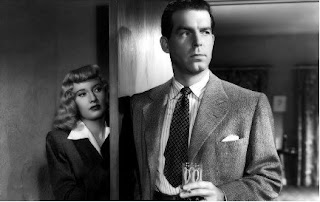
Double Indemnity – A noir classic and one of my favorite movies. Double Indemnity exemplifies what makes film noir film noir: doomed love, murder, the perfect crime, first person narration, flashback structure, stylistic cinematography. Fred MacMurray, Barbara Stanwyck and Edward G. Robinson are brilliant and the dialogue is some of the best in all of film noir.

Gun Crazy – A precursor to Bonnie and Clyde, this movie follows the tragic love affair of a couple whose love for each other is matched only by their love of guns. Shocking for its day, the cinematography in this film takes steps that are way ahead of its time. The famous one-take Hampton Robbery sequence alone is reason enough to watch.

Detour – While noir films were traditionally low budget movies, Detour makes the Maltese Falcon look like Pirates of the Caribbean. Shot in six days, Edgar G. Ulmer’s incredibly sparse and fatalistic tragedy about a traveling man whose every move seems cursed by bad luck is creepy creepy creepy and will leave you feeling paranoid for days.

Rififi – This one set the standard for all heist films to come. Jules Dassin’s direction of this French movie is astounding not only for his typically gorgeous visuals, but for the unbelievable suspense he creates. The famous heist sequence runs a quarter of the film’s length without music or dialogue, and manages to be one of the most captivating scenes I’ve ever watched.

Leave Her to Heaven –Despite being shot in color, this movie is typically referred to as a part of the noir cycle because of Gene Tierney’s terrifying portrayal of Ellen Berent, a femme fatale that will scare the crap out of you. Without spoiling anything, the silent drowning sequence in this film still gives me chills.

These are just a few. I will go into more in the next entry. However as it is late and I cannot think of a clever way to end this one, I will close with a chunk of dialogue from Double Indemnity. This is one of many reasons why I love film noir:

Neff: I wish you’d tell me what’s engraved on that anklet.

Phyllis: Just my name.

Neff: As for instance?

Phyllis: Phyllis.

Neff: Phyllis, huh. I think I like that.

Phyllis: But you’re not sure.

Neff: I’d have to drive it around the block a couple of times.

Phyllis: Mr. Neff, why don’t you drop by tomorrow evening around 8:30. He’ll be in then.

Neff: Who?

Phyllis: My husband. You were anxious to talk to him, weren’t you?

Neff: Yeah, I was. But I’m sort of getting over the idea, if you know what I mean.

Phyllis: There’s a speed limit in this state, Mr. Neff, 45 miles an hour.

Neff: How fast was I going, Officer?

Phyllis: I’d say around 90.

Neff: Suppose you get down off your motorcycle and give me a ticket.

Phyllis: Suppose I let you off with a warning this time.

Neff: Suppose it doesn’t take.

Phyllis: Suppose I have to whack you over the knuckles.

Neff: Suppose I bust out crying and put my head on your shoulder.

Phyllis: Suppose you try putting it on my husband’s shoulder.

Neff: That tears it…

Tuesday, July 28, 2009

Barbara Stanwyck 101 from Bridget Dougherty, stage manager


So in this play, Barbara Stanwyck comes up a lot. Having only known her in comedies, it was an eye opener to see all of the other work she did and how long she acted. In the play she comes up as a drink (a lot) and the character Barbara “like Stanwyck” references her.

Here’s a little about her, borrowed liberally from IMDB:

Barbara Stanwyck
1907-1990

Birth Name
Ruby Catherine Stevens

Mini Biography
Today Barbara Stanwyck is remembered primarily as the matriarch of the family known as the Barkleys on the TV western "The Big Valley" (1965), wherein she played Victoria, and from the hit drama "The Colbys" (1985). But she was known to millions of other fans for her movie career, which spanned the period from 1927 until 1964, after which she appeared on television until 1986. It was a career that lasted for 59 years. She was an extremely versatile actress who could adapt to any role. Barbara was equally at home in all genres, from melodramas, such as Forbidden (1932) and Stella Dallas (1937), to thrillers, such as Double Indemnity (1944), one of her best films, also starring Fred MacMurray (as you have never seen him before). She also excelled in comedies such as Remember the Night (1940) and The Lady Eve (1941). Another genre she excelled in was westerns, Union Pacific (1939) being one of her first and TV's "The Big Valley" (1965) (her most memorable role) being her last. In 1983, she played in the ABC hit mini-series "The Thorn Birds" (1983), which did much to keep her in the eye of the public.


Trivia
Her stage name was inspired by a theatrical poster that read "Jane Stanwyck in 'Barbara Frietchie.'".
In 1944, when she earned $400,000, the government listed her as the nation's highest-paid woman.
Often called "The Best Actress Who Never Won an Oscar."
Her mother died when she was accidentally knocked off a trolley by a drunk. Barbara was four at the time.
Was listed #11 on the American Film Institute's "100 Years of The Greatest Screen Legends."
Her stormy marriage to Frank Fay finally ended after a drunken brawl, during which he tossed their adopted son, Dion, into the swimming pool. Despite rumours of affairs with Marlene Dietrich and Joan Crawford, Stanwyck wed Robert Taylor, who had gay rumours of his own to dispel. Their marriage started off on a sour note when his possessive mother demanded he spend his wedding night with her rather than with Barbara.
She did not have a funeral and has no grave. Her ashes are scattered in Lone Pine, California.
Her performance as Phyllis Dietrichson in Double Indemnity (1944) is ranked #98 on Premiere Magazine's 100 Greatest Performances of All Time list (2006).
A Star Is Born (1937) starring Janet Gaynor and Fredric March is said to be modeled after Stanwyck's rise to stardom and first husband Frank Fay's descent into obscurity.
More info can be found at IMDB.com